

What is FMECA? Meaning, explanation, and examples
What is FMECA?
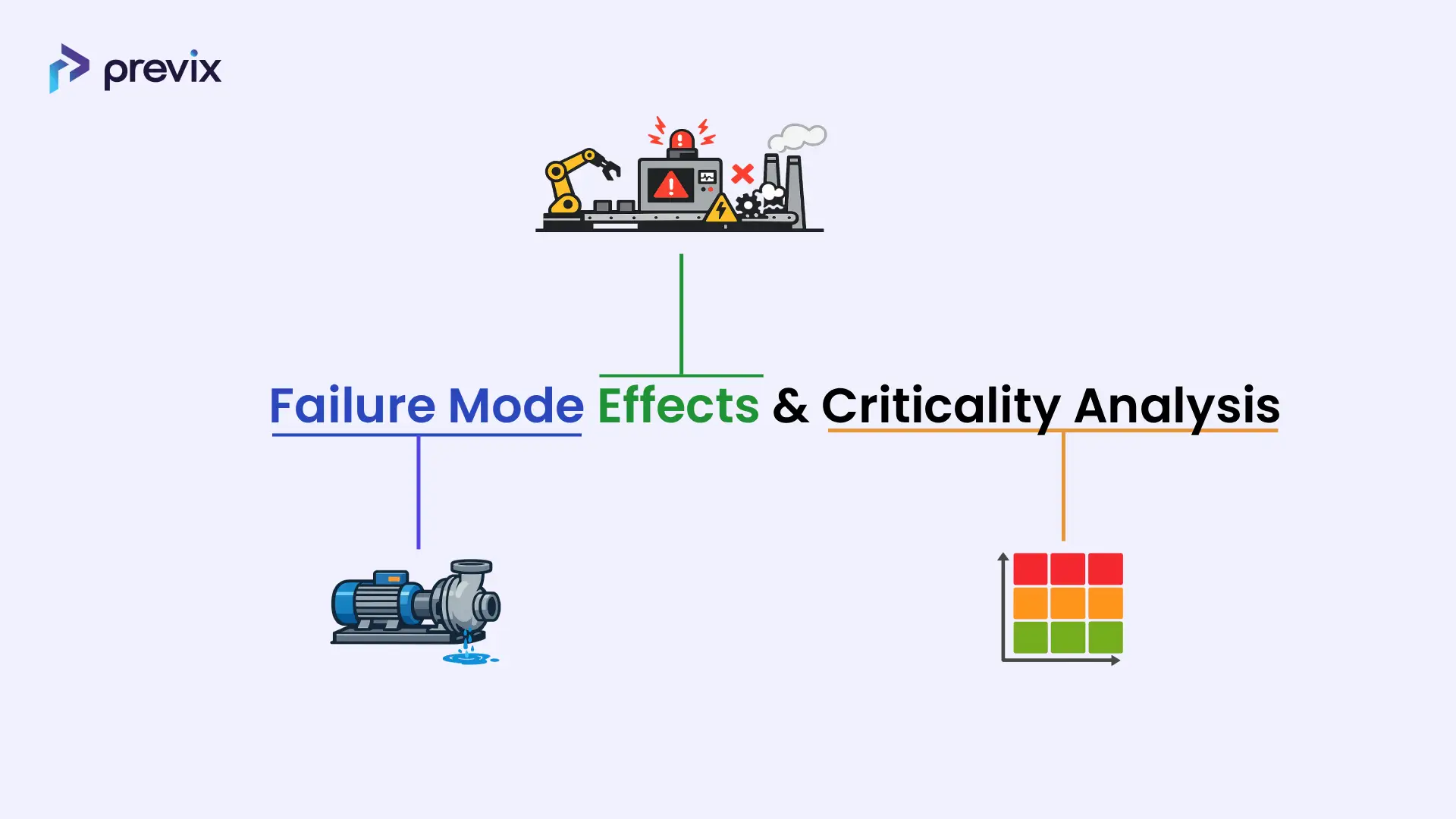
FMECA (Failure Modes, Effects & Criticality Analysis) is a method used in capital-intensive organizations to determine where preventive maintenance is truly needed and where you can deliberately choose corrective maintenance. By mapping potential failure modes of assets, describing the effects, and assessing criticality, you build a rationale for which assets to maintain preventively and which not to.
In sectors where reliability, compliance, and cost control directly impact output and margin, FMECA helps base maintenance decisions on risk and business impact instead of assumptions. In practice, the analysis is often facilitated by a reliability or maintenance engineer and completed together with maintenance, operations, and engineering. When time, capacity, or specialized knowledge is limited, organizations regularly engage external support to guide the process and deliver the analysis.
The result is a better-balanced maintenance strategy: focused preventive maintenance on what is truly critical, and cost-aware handling of less critical parts. This provides a clearer view of critical spare parts and ultimately reduces unplanned downtime, lowers maintenance costs, and improves safety and reliability.FMEA, the predecessor of FMECA, was first developed in 1949 by the U.S. Army to improve the reliability of weapon systems.
FMECA and AI
FMECA is known as a powerful but labor-intensive method. With AI support, FMECA can be carried out in a fraction of the time. AI helps with identifying failure causes, searching manuals, making initial MTBF estimates, and suggesting maintenance actions.
FMECA combined with AI does not replace the expert, but makes expertise scalable. Engineers validate and refine outcomes so you can reach a consistent, well-founded FMECA faster.
What does it deliver?
Below are the key drivers for performing FMECA:
Increase reliability and reduce downtime
Prevent unplanned downtime by identifying failures with the greatest impact on production and preventing them proactively — and directly improve your OEE (especially Availability).
Safeguard safety, environment, and compliance
Map risks to people and the environment and comply with legal requirements such as COMAH to maintain your license to operate.
Optimize spare parts management
Determine which spare parts are truly critical to keep in stock and avoid high inventory costs and long downtime.
Save on preventive maintenance
With FMECA you may find you are doing too much preventive maintenance, and can extend intervals or apply a run-to-failure strategy because an asset is not critical.
Move from reactive to proactive control
With FMECA you shift from constant firefighting to targeted preventive maintenance. You no longer spend time on unexpected failures, but on planned actions that prevent downtime and keep your organization in control.
Business case for improvement programs
Use FMECA to determine where Predictive Maintenance or design changes add the most value and support investment decisions.
In addition, FMECA helps document critical maintenance knowledge, supports audits and certifications, and provides input for decisions on asset life extension or replacement.
FMECA step-by-step plan
An FMECA is carried out in several steps:
Define the system
Start by clearly defining the system you will analyze. This includes setting boundaries, components, and subsystems, for example using P&IDs (Piping and Instrumentation Diagrams).
Create a risk matrix
A risk matrix helps estimate and prioritize risks based on likelihood and severity. It is aligned with goals such as safety, cost, and quality. Each combination of likelihood and consequence receives a risk level, from acceptable to unacceptable.
Determine the functions
Map the system functions first to understand which failures could cause the system to no longer function properly.
Identify failure modes
After determining functions, identify all possible failure modes that can disrupt these functions, including the underlying component that may fail.
Determine failure causes
For each failure mode, identify the underlying failure causes. Understanding these causes is crucial for defining the right measures to prevent future failures.
Describe failure effects
Describe what happens if a failure mode occurs in a worst-case scenario. This helps later in accurately assessing the severity of consequences.
Determine the likelihood
In this step, assess how often each failure cause occurs, for example based on historical data, technician experience, supplier information, or expert judgment.
Determine the consequences
Based on the described failure effects, determine the specific consequences of failure, such as impact on downtime (MTTR and spare part lead time), safety, cost, and environment, according to the risk matrix criteria.
Determine criticality
Criticality of each failure cause is determined by combining likelihood and severity of consequences, as defined in the risk matrix.
Define mitigating actions
Based on criticality, define and document the specific actions needed to prevent failure causes or limit their impact. Critical failure causes are mitigated with targeted preventive maintenance activities, while less critical causes can often be managed with a run-to-failure strategy.
Implement actions in the maintenance system (EAM)
The final step is implementing the defined actions, such as creating or adjusting the maintenance plan in the EAM system, such as Ultimo, SAP, Maximo, or Hexagon.
Continuous improvement and updates
After implementation, the FMECA is used as a living document and continuous improvement is secured via PDCA cycles. Failures, failure behavior, and maintenance findings are monitored and analyzed. This data is used to validate or adjust assumptions in the FMECA, such as failure causes, likelihoods, maintenance frequencies, consequences, and criticality. Based on these insights, the FMECA is periodically updated and maintenance strategies and actions are adjusted so risk control remains current and effective throughout the system lifecycle.
Practical examples
FMECA is widely used in the manufacturing industry across very different challenges. Below are three case examples showing how this method helps reduce downtime, manage safety and environmental risks, and optimize spare parts inventory.
Energy producer reduces downtime
At a power plant, FMECA revealed critical failure causes in turbine cooling systems. Preventive inspections and targeted replacement of high-risk components reduced unplanned downtime and improved the reliability of the energy supply.
COMAH company safeguards safety and environment
A chemical company under COMAH obligations used FMECA to analyze safety valves, emergency shut-off valves, and storage tanks. The result: tightened inspection intervals, additional detection mechanisms, and demonstrable compliance with regulations.
Bakery optimizes spare parts inventory
An industrial bakery had a large spare parts inventory but little insight into what was truly critical. Thanks to FMECA, it became clear which parts needed immediate availability and which were lower priority. Inventory value dropped by 25% without added downtime, and stock management became much more efficient.